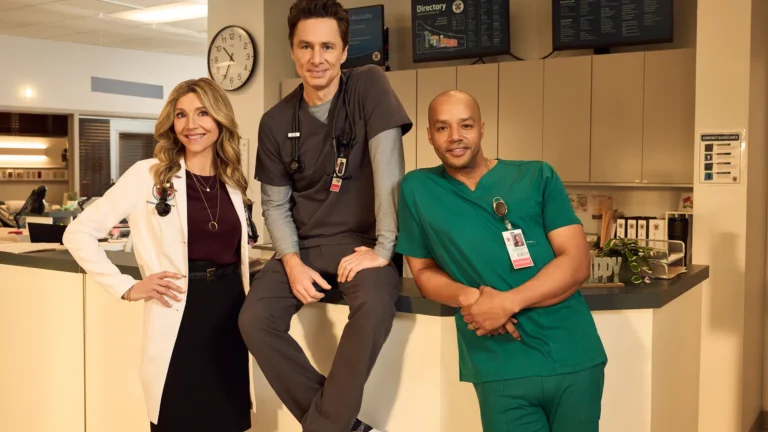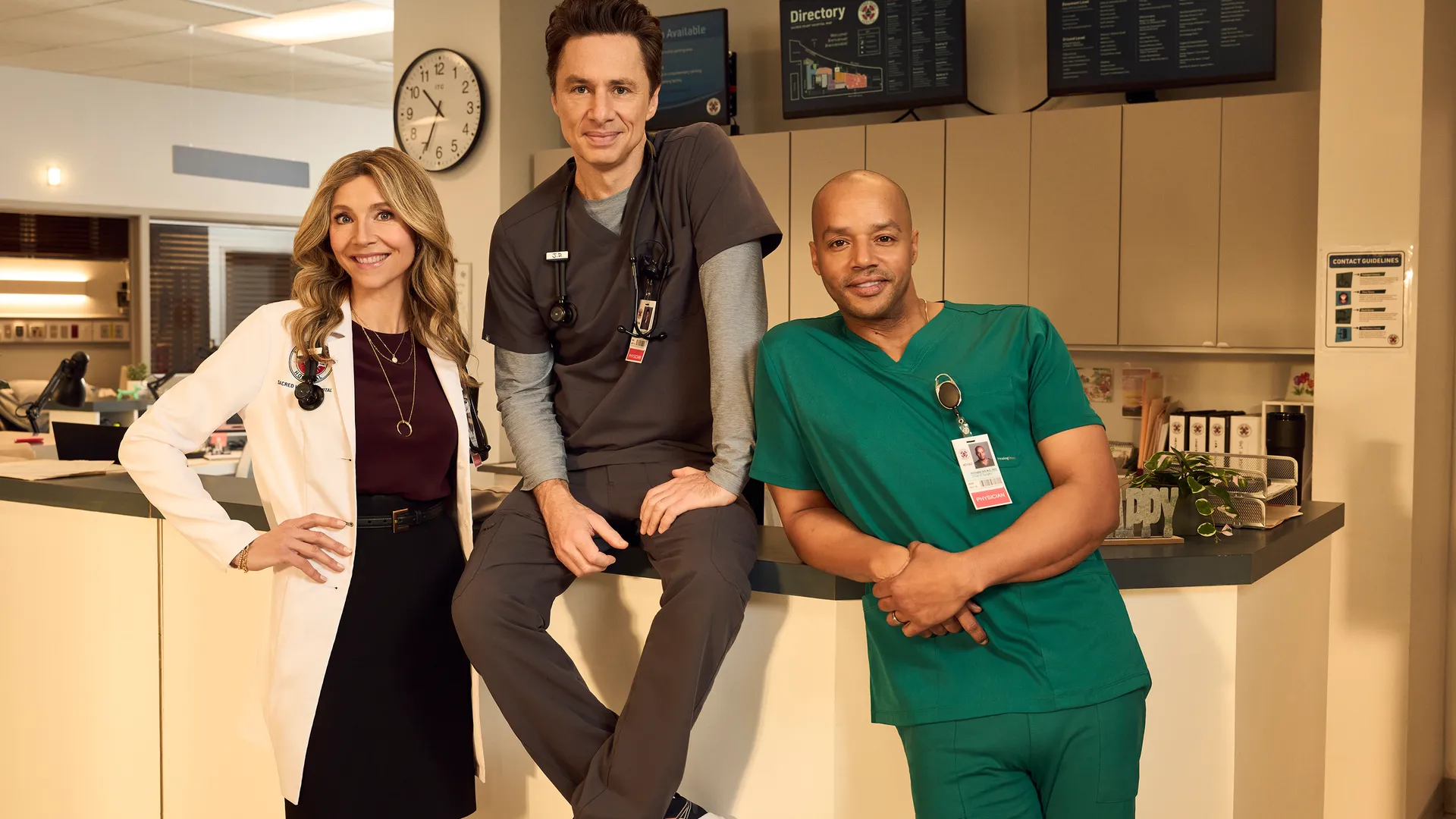
Scrubs / Brian Bowen Smith
There’s no escaping the trend of American TV series revivals: they require less effort, capitalize on nostalgia, and guarantee (or at least should guarantee) solid ratings. In the realm of sitcoms and comedies, however, the recent reliance on reboots and similar ventures hasn’t worked—just think of the painful return of Will & Grace or the dreadful Sex and the City—with one exception: Scrubs. The ninth and final season, alas a painful one, ended about fifteen years ago, and no one had considered the possibility of a return. “We were all focused on future projects, on life after Scrubs,” recalled Donald Faison, who played Turk. Creator Bill Lawrence continued to rack up successes, going on to create the wonderful cult classic Ted Lasso more than five years ago, followed by the well-received Shrinking and Rooster.
His series feature a revolving door of familiar faces, and the cast of the original Scrubs—Zach Braff, John C. McGinley, Sarah Chalke, and Faison—has continued to orbit within the creative universe of the producer who has made “positive thinking” both a stylistic hallmark and a mission. For him, it was easy to reunite them, and one of the first things you notice from the four episodes previewed for the press is that the chemistry between the actors playing JD, Elliot, and Turk remains just as strong as ever.
The show opens with JD’s return to Sacred Heart after a stint as a private practitioner: Cox hands over his position to him, and the news is a blow to the heart—how can he move forward without the paternal cynicism and cosmic pessimism of the mentor to fledgling doctors? The justification, however, is more valid: in the era of political correctness, the doctor’s blunt methods and mocking jokes are systematically stifled by institutional champions of form over substance (namely, human resources managers).
Fortunately, the first and greatest bromance on the small screen—that between JD and Turk—proves immune to the passage of time, and their dynamic remains as familiar and warm as a hug. Lawrence doesn’t try to reinvent the formula but rather seeks a balance between nostalgia and contemporary relevance. On the one hand, the soul of Scrubs remains the same—we find the same camaraderie, the same well-oiled ensemble, the same humor. In an era where creativity and dreams are suffocating to death, JD continues to live in his world of surreal and extravagant fantasies.
The modern touch comes from the new generation—a fresh group of graduate students and their respective characters to be woven into the show’s dynamics: Serena (Ava Bunn), Asher (Jacob Dudman), Blake (David Gridley), Amara (Layla Mohammadi), and Dashana (Amanda Morrow). Among them, Sam stands out, living in symbiosis with her smartphone and embodying Generation Z’s obsession with social media (Cox calls it “TikTok”). The most emblematic new character is Sibby, head of a program aimed at ensuring the well-being of hospital employees: you can’t yell at them, you can’t subject them to too much stress, and you can’t assign them shifts that are too long.
It’s no surprise that Cox can’t stand her: how can she train a new generation of hospital doctors if she can’t teach them to survive one of the toughest professions ever? The first episodes aim to strike the right balance not only between new and old characters but also between new and old ways of “feeling,” and in doing so, they directly contrast the purity, sweetness, and spontaneity of the emotions and how JD & co. express them with the forced nature of feelings expressed through the woke filter of what can and cannot be said.
Tenderly irreverent, melancholically existential, Scrubs remains true to its essence, which stands the test of time. The world has moved on, but its legacy and message are still relevant, thanks to Lawrence, who remains steadfast in his mission to bring optimism and positivity to the world, even when things take a tragic and sad turn. Scrubs is still a hit because its strength—irony—is timeless. The creator knows that irony is a powerful weapon (and always will be); it is our brain that comes to our rescue when we are too desperate or too afraid, and this is exactly what happens in the show: Cox used his cynical humor to exorcise the darkness, and JD used (and still uses) humor to play down what frightened him.
About the Author