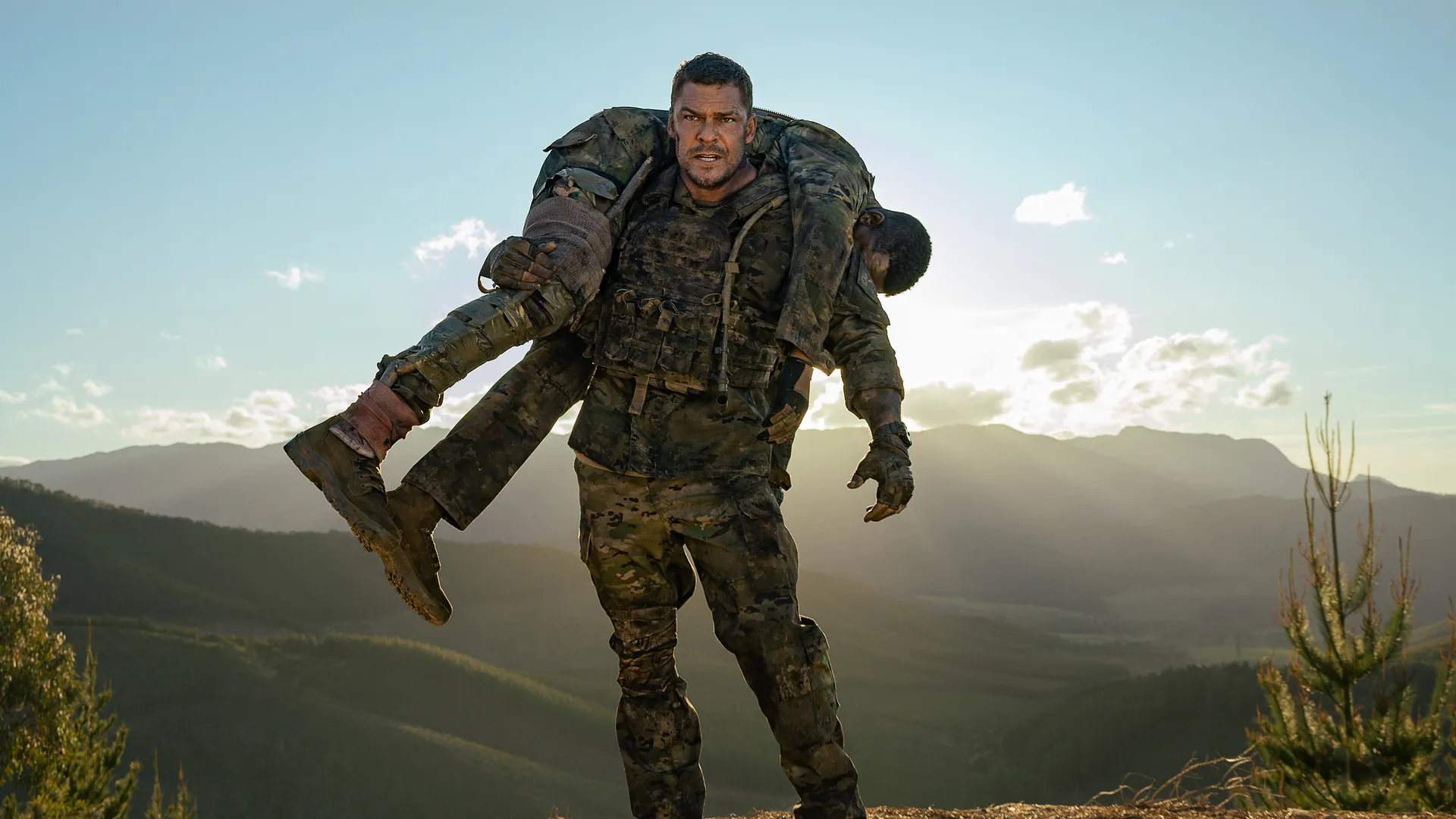
Image Credit: Netflix
Imagine if Schwarzenegger and the other soldiers in Predator were being hunted—not by a belligerent Rastafarian alien, but by a massive war machine that looks like a cross between Robocop’s ED-209, Tron’s Recognizer, and the massive Deathbringer from Horizon Zero Dawn: meet War Machine, the sci-fi war action film that’s taking Netflix by storm and hasn’t budged from the top of the streaming service’s Top Ten most-watched movies for the past ten days. The equivalent of a new-millennium direct-to-video release, with a basic plot and a lead actor with a TV background, the latest work from Patrick Hughes of The Expendables 3 is a smash hit, thanks to an effective and clever formula—essentially an evolution of The Asylum’s formula (the production company specializing in B-grade horror and Hollywood rip-offs) . But let’s take a step back.
In Afghanistan, a highly decorated sergeant with a degree in mechanical engineering joins his brother on a mission. It ends disastrously: his brother and everyone else in the platoon are blown to pieces in a Taliban attack, just moments after the two had sworn to each other that they would become Army Rangers together. A couple of years pass, and physically battered and devastated by post-traumatic stress, the sergeant decides to pursue that career on his own, just in time to be sent on a mission, with a handful of fellow soldiers, to the place where a massive alien war drone has just landed. In less than two hours, the clearing in the mountains where the soldiers are stationed (kudos to the locations—the film was shot in Australia and New Zealand) transforms into the equivalent of the jungle from Predator, that is, a natural trap. The sergeant and the others, all identified only by a number, try to escape the weapon of destruction.
A century ago now, back in the days of straight-to-video VHS releases and Blockbuster, a large portion of the film market was actually intended for the small screen. Thousands of low-budget action, horror, and sci-fi films—ranging from B to Z-grade—kept an entire generation of sleepless genre film lovers company. Films like Death Machine, a 1994 title that was a regular fixture on Italian late-night TV schedules, of which War Machine is essentially the evolution. The winning formula mentioned above is a mix of action and military sci-fi featuring a TV action hero—in this case, Alan Ritchson, the star of Prime Video’s beloved Reacher—along with a handful of former A-list Hollywood actors who are now a bit past their prime (Dennis Quaid, Esai Morales, Jai Courtney), an intellectually undemanding story (a traumatized but invincible soldier hunted by a relentless killing machine), a nod to major titles like the aforementioned Predator, Terminator, and War of the Worlds, and the prospect of several sequels.
War Machine stands out with a substantial budget—reportedly $80 million—and a protagonist who is decidedly more complex than your typical Dutch Schaefer, featuring Ritchson as a super-soldier torn apart by inner demons, a mountain of smart muscle who uses his intelligence to take on the alien enemy. If we choose, with some effort, to ignore the rabid militaristic propaganda the film shoves down our throats—especially in the final moments—War Machine is a fun, big-budget spectacle, and it’s a thousand times better than its embarrassing first cousin that attempted the same thing a few months earlier and failed spectacularly: obviously we’re talking about War of the Worlds starring Ice Cube and Eva Longoria and produced by Timur Bekmambetov of Night Watch (Timur, why?), which landed on Prime Video last summer and was the big winner at the recent Razzie Awards. Unwatchable, whereas we’d definitely give War Machine 2 a look.
About the Author